
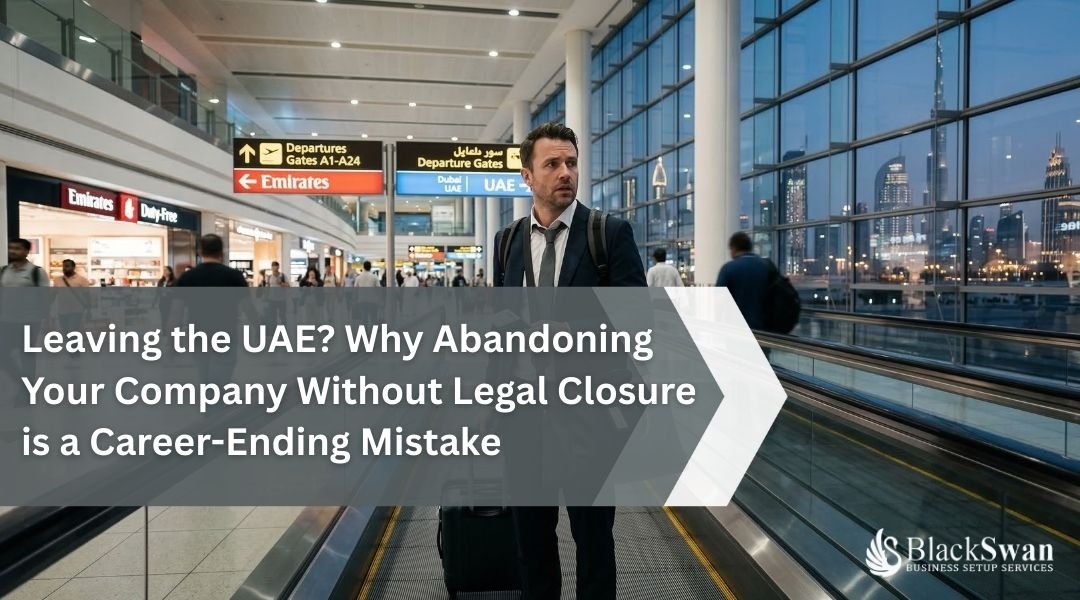

Let’s be honest for a moment. Leaving a business behind is never easy. It’s usually an emotional, stressful, and, let’s face it, financially draining rollercoaster. And in a city as fast-paced and uncompromising as Dubai, where the hustle never stops, the temptation to just pack up, lock the door, and jump on that plane back to London, Karachi, or New York without looking back can be overwhelmingly strong. You’re done. The market shifted, a bigger opportunity knocked elsewhere, or maybe the realities of running a setup in a dynamic global hub like DIFC or Business Bay just got to be too much. We get it. The pressure is immense.
But here’s the cold, hard truth that you absolutely cannot afford to ignore, no matter how tired or ready to move on you are. Simply walking away from your UAE company without properly and legally winding it up is, without a single shred of hyperbole, one of the single biggest, most devastating career and financial mistakes you could ever make. This isn’t just about a few loose ends or some annoying paperwork you can ignore. It is not something you can just ‘deal with later.’ It is a full-blown ticking time bomb that will not only detonate your financial health and destroy your reputation in the region but will quite literally chase you across the globe, ensuring that your time in the Emirates becomes a permanent, crippling stain on your professional future.
Think I’m exaggerating for the sake of a headline? I’ve seen this play out far too many times. I’ve spoken with former entrepreneurs who are now, years later, stuck in their home countries, blacklisted from entire GCC banking systems, unable to secure simple loans, facing random, life-altering legal notices they don’t even understand, and, most gut-wrenchingly, completely barred from ever returning to the UAE even for a vacation or a layover due to active, unresolved travel bans triggered by their abandoned business liabilities. What was supposed to be a chapter in their life turned into a lifelong nightmare.
So, let’s cut through the noise and talk about what actually happens when you choose the ‘abandon’ route over the ‘proper closure’ route. It’s not a pretty picture, and it’s one you need to see clearly before you make a decision that you will deeply, profoundly regret.
The Myth of ‘Just Leaving’
Many entrepreneurs operating on the fringes or under significant pressure convince themselves that they can just ‘fade into the background.’ They stop paying the rent on that small space near Sheikh Zayed Road, they stop answering emails from their trade license consultant, and they assume that because they’ve physically left the building, the legal entity—and all its massive, accumulated responsibilities somehow just ceases to exist.
This could not be further from the truth. In the eyes of UAE authorities, banks, and the entire ecosystem, that company is still active and fully operational, and you—the manager, the shareholder, the signature on the bank account—are responsible. Every. Single. Day. When you abandon your company, you aren’t ending it; you are abandoning your legal fiduciary duty, and that, in the UAE, has severe, non-negotiable legal and financial consequences.
When the Bills Keep Coming (Even When You’re Not There)
One of the most immediate and painful traps is the financial domino effect. Just because you aren’t in Dubai, doesn’t mean your business liabilities stop accumulating.
Think about your office space. You likely have a lease agreement, likely registered through Ejari, for that space in a place like Business Bay. When you stop paying rent and just leave, your landlord—often a well-capitalized developer or individual investor—won’t just nod and move on. They have a contract. They will file a rental dispute at the Dubai Land Department. This isn’t a small ‘landlord-tenant’ tiff; it’s a formal legal action against your company, and often, you personally as the guarantee or manager.
What about DEWA and EMPOWER/cooling costs? These seem trivial until you realize that in your absence, and without proper, formalized disconnections, these charges keep accruing. Not just the base rate, but penalities, late fees, and massive reconnection charges. DEWA, in particular, has become extremely adept at tracking and recovering outstanding debt. An abandoned DEWA bill of AED 1,500 can, within a year, easily balloon to ten times that amount due to non-payment penalties, which, of course, becomes a personal liability linked to your Emirates ID and passport.
The Red Flag That Never Goes Down
And here’s where the trap truly starts to close. When multiple government entities (like DEWA, the Department of Economy and Tourism (DET), and your local Free Zone Authority), along with your landlord and suppliers, all start filing non-payment cases against a company that has effectively disappeared, you trigger a system-wide alert. This isn’t just a list; it’s an active, real-time database accessible to government authorities and, most critically, all UAE banks.
This leads to a cascade of ruinous consequences:
- Blacklisting by UAE Central Bank: Your personal name, Emirates ID, and passport number are entered into the Central Bank’s database for financial misconduct and unresolved debt. This immediately flags you with every single financial institution in the country. Forget about ever opening another bank account, getting a credit card, or securing a mortgage in the UAE, ever again.
- The Travel Ban: This is the one that destroys people. When a civil case for debt (e.g., from your landlord or a supplier) is filed against your company and you, a common outcome is the imposition of a travel ban. You could be pulled aside at Dubai International Airport (DXB) or any other UAE point of entry, even ten years from now, and be arrested on the spot due to an active, unresolved financial dispute from a company you ‘just left’ back in 2024. Your family vacation? Gone. Your crucial business layover? A nightmare of detention and legal bureaucracy. This is not a hypothetical scenario; it happens constantly.
- AECB Credit Score Ruination: Your personal Etihad Credit Bureau (AECB) score is tied intimately to your financial conduct. Abandoning your company’s financial obligations, including bank loans, credit lines, and even supplier payments, will plummet your personal score to the absolute bottom. This negative report will make you financially radioactive, not just in the UAE but globally, as international banks often have data-sharing protocols or visibility into your history.
The Damage to Your Most Valuable Asset: Your Reputation
Let’s assume, for a second, that you do manage to avoid a travel ban or a bank judgment. What about your professional reputation? In a hyper-connected global hub like Dubai, your word and your history are everything. The business community in DIFC or the trade world in Deira is smaller and far more gossipy than you think. News travels fast.
If you have built a reputation in the region as an expert, a reliable supplier, or a respected consultant, abandoning your company is the professional equivalent of burning your bridges and then pouring cement over the remains. Your peers, your former partners, and your former clients will find out. In fact, many of them will be the ones trying to track you down for unpaid bills. They will remember. And in our digitized world, where a quick LinkedIn or Google search reveals so much, do you really want the words ‘unresolved legal disputes’ or ‘financial misconduct’ to be associated with your name?
When your reputation is shredded in one of the world’s leading business markets, you haven’t just lost a company; you’ve deeply damaged your entire career trajectory.
The Human Cost of ‘Ghosting’ Your Responsibilities
Finally, there’s the ‘Human Factor.’ Abandoning your company often means abandoning your team. This is about your colleagues, your employees the people who worked alongside you in that office on Sheikh Zayed Road. When you ‘ghost’ your responsibilities, you are leaving your staff with unpaid salaries, uncancelled visas, and in a state of absolute legal limbo.
In the UAE, a company that isn’t properly closed cannot cancel its employees’ visas. This means your former team members are stuck. They cannot work for a new employer, they cannot travel, and they cannot even legally remain in the country without a valid, renewed visa. This often forces them to seek legal recourse against your defunct company, leading to further court judgments and human misery. Is that a legacy you want to leave behind?
Choosing the Proactive, Professional Path to ROI and Reputation
So, what’s the alternative? It’s not simply running. It’s facing the reality. If you need to exit, you do so professionally, legally, and with a long-term vision. This means engaging a proper business setup (and closure) expert. It means:
- Auditing your Liabilities: Get a clear picture of exactly what is owed to who DEWA, rent, suppliers, staff salaries, and bank loans.
- Cancelling All Visas: This is not just about the government; it’s about freeing your people so they can move on with their lives.
- Formal Winding Up: This involves a clear legal process with the relevant authority (e.g., DET or your Free Zone), which includes gazette publications to invite any creditor claims.
- A Final Audit and No Objection Certificate (NOC): Securing that final, signed-off clearance.
We understand that the traditional model of setting up an entire office from scratch feels incredibly daunting, which is part of the anxiety that drives entrepreneurs to feel overwhelmed. But the modern landscape of access and infrastructure in Dubai, like what you find with a premier provider like BS Business Center in Business Bay, offers a smart path forward. Leveraging their expertise and their ready-made office solutions can radically streamline your setup, and also, just as critically, provide you with the robust, professional base that supports you in managing your closure when the time comes, rather than trying to juggle it yourself. You can learn more about how they can help stabilize your local operational foundation at https://bsbusinesscenter.com/. This isn’t an ad; it’s about a smarter way to manage the infrastructure of your entire business lifecycle.
Leaving the UAE is a strategic move, not an act of desperation. Abandoning your company is a decision that trades a momentary relief for a lifetime of legal and financial chaos. Make the professional choice. Face the closure. End your company, but keep your future and your reputation intact.
Frequently Asked Questions (FAQ)
Q1: Can I just let my trade license expire instead of formally closing it? Human Answer: That is a terrible idea. An expired license isn’t a closed company. Penalties for non-renewal pile up, and you’re still legally responsible for all its debts, lawsuits, and visa liabilities. Authorities see it as active neglect, not closure.
Q2: What’s the worst that can happen if I leave without a proper closure? Human Answer: Think bigger than a fine. You risk an active travel ban (arrest at the airport on your next visit), being blacklisted from all UAE and many international banks, having all your personal UAE bank accounts frozen, and destroying your credit score for life. It will track you across the globe.
Q3: Is it possible to get a travel ban lifted later from abroad? Human Answer: Highly, highly unlikely without paying the full debt. To even attempt this, you’d need to hire a UAE lawyer to act on your behalf, and they would need the full sum of money to settle the court cases and satisfy the creditor who requested the ban. It’s an expensive, uphill battle.
Q4: Do these financial problems really affect my credit score in my home country? Human Answer: Yes, and this is what blindsides most people. UAE banks are aggressive in recovering debt. They sell the debt to international collection agencies, which will report non-payments and court judgments to credit bureaus in your home country, ruining your ability to get a loan or mortgage anywhere.
Q5: What happens to my staff if I just abandon the company? Human Answer: This is the human cost. Your staff will be left in a legal nightmare. Their visas cannot be cancelled, meaning they are stuck, can’t work elsewhere, and will likely face immigration fines themselves. You’re not just ‘ghosting’ your bills; you’re ghosting people’s lives.
Q6: What’s the difference between Free Zone and Mainland closure processes? Human Answer: Both require proper winding up, but the specifics differ. Each Free Zone has its own set of distinct regulations and fees. Mainland closures are managed by the Department of Economy and Tourism (DET) and involve specific steps like appointing a liquidator. Both require deep expertise to avoid mistakes.
Q7: Can I not just hire a lawyer after I’ve already left to handle it? Human Answer: You can, but it’s astronomically more expensive, complex, and stressful. A proper, proactive closure is much more affordable than paying lawyers’ fees later and battling already-established court judgments and travel bans that have had years to fester.
Setting up in the UAE or GCC?
Tell us what you plan to set up and a consultant replies within one working day.

