
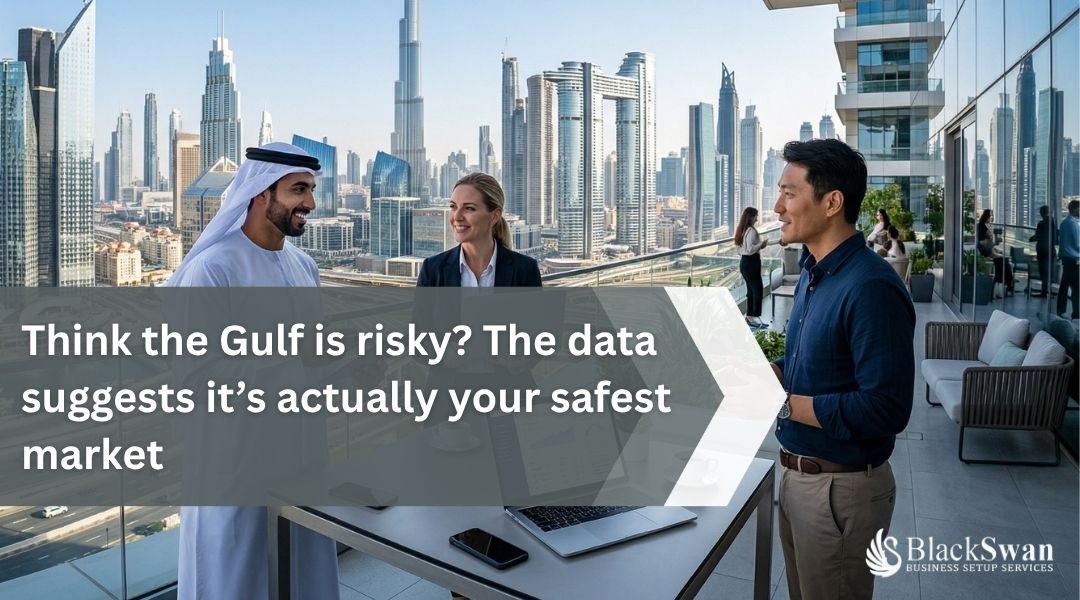

If you’ve spent the last decade skimming mainstream Western headlines, you likely view the Gulf through a lens of “geopolitical volatility.” It’s a tired trope, isn’t it? The image of a region perpetually balanced on a knife-edge, vulnerable to every shift in the global energy market. But as someone who tracks the digital and economic pulse of this market daily, I have to ask, when was the last time you actually looked at the hard numbers?
While traditional “safe” havens in Europe and North America are currently wrestling with stubborn inflation, creaking infrastructure, and political gridlock, the Gulf has quietly morphed into a global fortress of stability. It’s not just about oil anymore. We’re witnessing a calculated, data-driven transformation that has turned the UAE, Saudi Arabia, and Qatar into some of the most predictable environments for capital on the planet. Honestly, the real risk in 2026 might be staying exactly where you are.
The Great Diversification Isn’t a Goal, It’s the Current Reality
For years, the skeptical refrain from analysts was: “What happens when the oil runs out?” Well, look around. The answer is unfolding in real-time. According to the latest 2026 World Bank reports, GCC economies are projected to grow by 4.5%, driven almost entirely by a robust non-oil sector that now accounts for over 60% of the region’s total GDP.
In the UAE, greenfield Foreign Direct Investment (FDI) isn’t just growing; it’s exploding. Verified data confirms a staggering 78% year-on-year surge in greenfield FDI capital, reaching a record $33.2 billion. You don’t see that kind of capital injection in “risky” markets. Investors aren’t just betting on a whim; they are moving into a geography where the regulatory framework is being rewritten specifically to protect them.
From 100% foreign ownership laws to the widespread rollout of “Golden Visas,” the Gulf has systematically removed the friction that usually makes emerging markets feel like a gamble. It’s about making it easy for global business to say “yes.”
A Hedge Against Global Volatility
Let’s talk about inflation—that silent killer of margins back in the West. While the US and EU have spent years trying to cool down overheating prices, inflation in the GCC has remained remarkably contained. S&P Global forecasts an average rate of just 2% for the region through 2026. Why? Because the fiscal policy here is proactive, not just a reaction to a crisis.
With currencies largely pegged to the US dollar and massive sovereign wealth funds—Abu Dhabi alone manages over $1.7 trillion in assets, acting as a “macroeconomic shock absorber,” the Gulf offers a level of currency stability that is increasingly rare. Think about it. When you’re running a digital agency or a tech startup, knowing your costs won’t skyrocket 15% overnight because of a central bank’s sudden mood swing is a massive competitive advantage. Is it really a risk to move to a market with zero income tax and world-class digital infrastructure? Or is the real risk staying where the tax man takes nearly half of your hard-earned growth?
The Talent Magnet: Why the “Brain Drain” is Reversing
A market is only as safe as the people who power it. We are currently witnessing a historic migration of talent and wealth. The 2025 Henley Private Wealth Migration Report highlights that the UAE is expected to see a record net inflow of 9,800 millionaires, the highest in the world, far surpassing the United States.
Why are they coming? Because Abu Dhabi was recently named the world’s safest city for the 10th consecutive year. When you combine that level of physical safety with world-leading 5G penetration and a government-led push into AI, you aren’t looking at a bubble. You’re looking at a new global headquarters. Saudi Arabia’s Vision 2030 and Qatar’s North Field expansion are creating a ripple effect of demand in construction, logistics, and fintech that is grounded in massive, state-backed infrastructure projects already past the point of no return. The cranes you see on the horizon are not speculative; they are the skeletons of a new global order.
The Verdict for 2026
If you are waiting for the “perfect time” to enter the Middle East because you’re worried about stability, you might be missing the most stable window in a generation. The data is screaming what the headlines often miss: the Gulf has decoupled its growth from global chaos.
We are no longer the “frontier.” We are the new center. The infrastructure is superior, the tax environment is unmatched, and the growth trajectory is backed by the largest capital reserves on Earth. If you’re looking for a safe haven for your business, look toward the desert. The oasis is real, and it’s open for business.
FAQs
Hardly. While oil is a great foundation, non-oil sectors like tourism and tech now drive the majority of the GDP in places like the UAE. It’s a much more balanced portfolio now.
It’s one of the biggest draws. Most GCC countries offer zero personal income tax and very competitive corporate rates, letting you keep what you actually earn.
Between the currency pegs to the dollar and low inflation, your purchasing power stays steady while the rest of the world deals with price spikes.
The crime rates are some of the lowest on the planet. Most expats find the quality of life and personal safety to be the biggest shock when they move.

