Office Time
Mon-Sat: 8am to 8pm


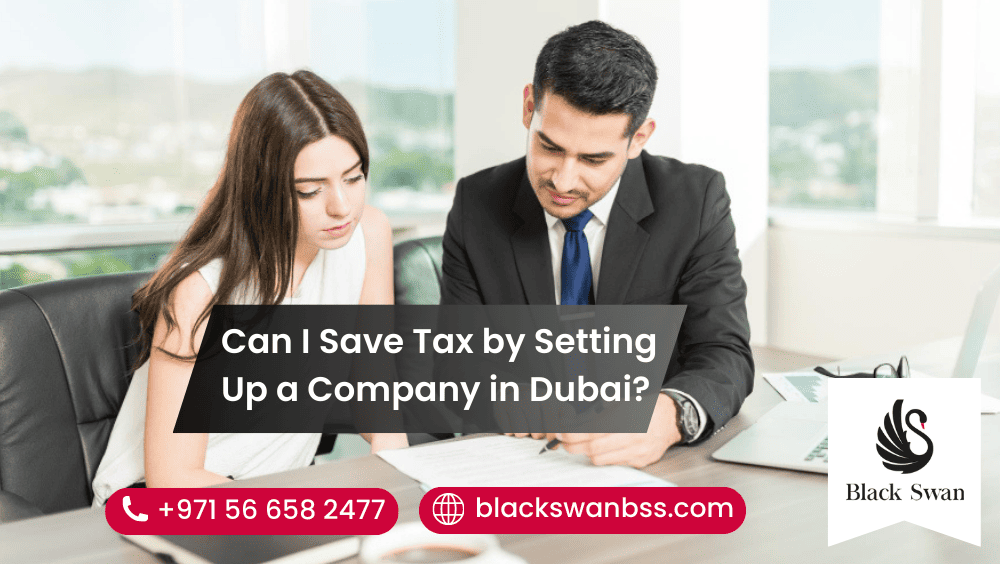
Yes, apparently you can save tax by setting up a company in Dubai, but only if you plan properly, understand the new UAE corporate tax rules, and choose the right structure.
Table of Contents
When people hear “Dubai”, they still think “zero tax”. However, the rules have changed:
Therefore, you don’t automatically avoid tax just by opening a company in Dubai. Instead, you need to structure your business setup in Dubai carefully.
When you plan company formation in Dubai, you typically look at three broad options.
|
Option |
Corporate Tax |
Typical Use Case |
|
Dubai mainland company |
0% up to AED 375,000; 9% above that |
Local trading, retail, onshore services |
|
Dubai free zone company |
0% on qualifying income if QFZP; 9% on other income |
International trade, online services, holding structures |
|
Offshore / holding structure |
Often 0% in UAE, but subject to home-country rules |
Asset holding, SPVs, international structuring |
Free zone tax benefits now depend on rules around qualifying activities, economic substance, and limiting non-qualifying income (usually below 5% or AED thresholds – the “de minimis rule”).
Usually, you may actually save tax with a Dubai business setup in several scenarios:
Apparently, If you move your genuine business operations to Dubai and become tax resident under UAE rules and also possibly non-resident in your previous country, after that :
However, your home country’s exit tax, CFC rules, and treaty network still matter. You should always check this with a qualified international tax adviser.
If you run an online or consulting business and sell mainly to clients outside the UAE mainland, a Dubai free zone company may:
Besides this, many digital businesses use free zones such as DAFZ, DMCC, JAFZA or IFZA, to minimize global effective tax rates while remaining compliant.
Apparently, for e-commerce and trading companies, Dubai free zones typically offer:
As a result, your effective global tax rate may drop significantly, especially if your current jurisdiction taxes corporate profits at 20–30%+.
To keep the 0% tax on qualifying income, your Dubai free zone company must usually:
If you don’t meet these conditions, your free zone business can lose its 0% status and pay 9% corporate tax on relevant income.
When we talk to entrepreneurs exploring Black Swan Business Setup Service, we see the same misconceptions:
Setting up a tax-efficient company in Dubai is not just about picking the cheapest licence. It is about integrating legal, tax, banking and substance into one clear plan.
Black Swan Business Setup Service can assist you with:
As a result, you don’t just “open a company in Dubai”; you build a sustainable, compliant structure that can genuinely optimize your tax position.
Related Articles:
» UAE Corporate Tax Law: Who Needs to Pay Tax?
» Difference Between VAT and Corporate Tax in Dubai
» Steps to Setting up a New Business in Dubai
» Benefits of Setting Up Your Business in Dubai
Is it possible for you to save tax by setting up a company in Dubai?
Yes, definitely, if you:
On top of that, Dubai remains one of the most attractive hubs globally for digital businesses, investors, consultants and entrepreneurs. Anyhow, the era of “set up and forget” is over. Therefore, Thoughtful planning with an experienced partner such as Black Swan Business Setup Service can turn Dubai into a powerful, compliant tax-efficient base instead of an expensive experiment.
Dubai is no longer completely tax-free. Most businesses now fall under the UAE corporate tax regime: 0% on taxable profits up to AED 375,000 and 9% on income above that. Certain free zone companies can still enjoy 0% on qualifying income if they meet QFZP conditions.
Yes, normally, a Dubai free zone company can still pay 0% corporate tax on qualifying income if it qualifies as a Qualifying Free Zone Person. Moreover, It must meet tests relating to limits on non-qualifying income, audited accounts, qualifying activities, and economic substance. Apart from that, the 9% rate applies to relevant income.
Usually, the UAE does not levy personal income tax on dividends or salaries. Anyhow, your home country may apply CFC rules or tax your worldwide income, therefore you must check local laws before relying on this benefit.
Not automatically. Honestly, many countries tax residents on worldwide income and have anti-avoidance rules. In addition, to genuinely reduce your overall tax burden, you may need to change tax residency, adjust your structure, or use a compliant holding setup, all under professional advice.
It usually depends on your business model. Mainland companies suit businesses that sell to the UAE market and accept the standard 0%/9% corporate tax slab. Consequently, Free zone companies can be more tax-efficient for export-oriented or online services if they qualify for the 0% rate on qualifying income and maintain substance.
“Qualifying income” generally means income from permitted activities carried out in or from the free zone — for example, services to foreign clients or dealings with other free zone entities — subject to detailed rules. Income from certain mainland activities, immovable property or excluded sectors may not qualify and is taxed at 9%.
Usually, yes. To meet the economic substance requirement, your free zone company should have adequate office space, real operating expenses and relevant employees or outsourced resources in the UAE. Paper-only “shell” companies risk losing their tax benefits.
Usually, most businesses in the UAE must register for VAT at 5%, subject to activity thresholds & turnover. Moreover, VAT is separate from corporate tax, so you need to handle VAT registration, returns and invoicing correctly even if your corporate tax rate is 0% on qualifying income.
Often not, or not entirely. Income from mainland clients is frequently treated as non-qualifying income and may be subject to 9% corporate tax or require a mainland branch/distributor structure. Careful planning is crucial before you start selling into the local market.
Yes. Even if you expect to pay 0% on qualifying income, you usually must register for corporate tax, maintain audited accounts, and file returns to prove your eligibility and avoid penalties.
Usually, Black Swan Business Setup Service can help you coordinate with tax & accounting partners, manage the company formation in Dubai, design a compliant structure, select the right jurisdiction (specific free zone vs mainland ) & assess your situation. Consequently, this approach helps you legitimately reduce your effective tax rate while staying within UAE and international rules.
If you’ve spent the last decade skimming mainstream Western headlines, you likely view the Gulf…
Let’s be honest for a moment. Leaving a business behind is never easy. It’s usually…
When you plan to launch a business in the Sultanate, the first question would be:…
When you plan to launch a company in the Sultanate, one question arises: how much…
Running a company in Dubai feels fast—your market changes, your brand changes, and sometimes your…
Dubai is meant for trade. And if your business depends on fast air connections, smooth…
If you want a premium Dubai free zone address, fast setup, and global credibility, DMCC…
If you are building a tech startup in the UAE, you will hear about Dubai…
Explore business opportunities with attractive packages for setting up of Business in Dubai, Abu Dhabi, Sharjah, RAK & Ajman
* T & C Apply
Low-cost Mainland company formation packages starting at great Offer. Incorporate business in Dubai, Abu Dhabi, Sharjah, RAK & Ajman
* T & C Apply
Start your business in the UAE Offshore get discount offer today On Dubai (JAFZA Offshore), RAK & Ajman Offshore !
* T & C Apply
Our connection with ministries and government bodies across the UAE help us obtain quick government approvals for our clients. Our consultants work closely with the Department of Economic Development (DED) and other government bodies in UAE to ensure the smooth and timely company formation
Setting up of business in UAE
Setting up of business in UAE
Get exact cost for setting up of business & company formation. Includes License Cost, Visa, Registration Fee, Office Cost, Consulting Fee etc
UAE: No: 3701. 3702 Citadel Tower Business Bay, Dubai
OMAN: No. 210, Beach Commercial Complex , Muscat
KSA: #184, HQ offices, Al-Wurud, Riyadh
UK: Bank House, 81, St. Jude's Rd, Egham, TW20 0DF
+971 56 658 2477 / +971 4 240 6939 (landline)
helpdesk@blackswanbss.com
Mon-Sat: 8am to 8pm
Get a customized quote as per your requirement & also get a free consultation with one of our experts.
UAE: No: 3701. 3702 Citadel Tower Business Bay, Dubai
OMAN: No. 210, Beach Commercial Complex , Muscat
KSA: #184, HQ offices, Al-Wurud, Riyadh
UK: Bank House, 81, St. Jude's Rd, Egham, TW20 0DF
+971 56 658 2477 / +971 4 240 6939 (landline)
helpdesk@blackswanbss.com
Mon-Sat: 8am to 8pm
Get a customized quote as per your requirement & also get a free consultation with one of our experts.

 ODR | Privacy Policy| T&C| Copyright| Cookies